Startup Hong Kong: The Complete Guide to Support Bodies, Funding, Communities and Launching in Asia
Key takeaways
Hong Kong's startup ecosystem rests on a few public bodies. StartmeupHK, part of InvestHK, helps founders set up and expand. Cyberport suits digital tech and offers incubation funding of up to HK$500,000 over 24 months. Hong Kong Science and Technology Parks suit deep tech and run a 24-month Co-Acceleration Programme. Government co-investment, including the HK$2 billion ITVF, sits alongside angels and venture capital. Meetup lists 31 technology startup groups. Support does not create visibility, so founders still need a localised launch with local proof and trusted channels.
This startup Hong Kong guide is for founders, product managers and marketers who are building a tech product in Hong Kong, or bringing one here from overseas. It helps you decide which support bodies, funding routes and communities deserve your time. It then shows how to turn that setup into a launch that people in Hong Kong, Taiwan and wider Asia actually notice.
The short answer: Hong Kong's startup scene runs on a few public anchors. StartmeupHK, run by InvestHK, helps founders set up. Cyberport and HKSTP run incubation. Government schemes, angels and VCs provide funding. Meetups and events supply the community. But being set up is not the same as being seen, so you need a launch plan too. Below, you will find who the support bodies are, the funding and incubation routes, the events and communities, how to launch and get noticed, and the common mistakes, plus who Hong Kong suits.
This guide is written from Hong Kong by the founder of Unwire Launch, which has helped products launch to Asian audiences, so the launch sections come from first-hand experience rather than a directory.
Who Supports Startups in Hong Kong: StartmeupHK, Cyberport, HKSTP and HKPC
If you are setting up or expanding from overseas, StartmeupHK is usually your first stop. It sits within InvestHK, the government department that attracts foreign business. It points you to company setup, visas, programmes and contacts. Its job is to help you land, not to fund you or sell your product for you.

Cyberport is the hub for digital tech. It focuses on fintech, digital entertainment, smart living and related software. If you build fintech, Cyberport is also the natural route into the regulators' sandbox schemes and the fintech community around them. It runs incubation, an accelerator support scheme and the HK$400 million Cyberport Macro Fund, which invests in ICT start-ups to help them attract other investors.
Hong Kong Science and Technology Parks (HKSTP) suits deep tech and R&D-heavy companies. Think biotech, robotics, hardware, materials and AI research with lab needs. Its programmes cover incubation and acceleration, including a Co-Acceleration Programme that runs for 24 months for acceleration-stage startups. Its TechnoPreneur Partnership Programme works with over 30 partner organisations.
The Hong Kong Productivity Council (HKPC) helps companies adopt technology and upgrade operations. It is often more relevant once you sell to manufacturers or established businesses. Industry groups add peer networks. The HKCS Startup Industry Group ran StartupHub Connect Series events at Hong Kong Science Park on 24 Apr 2025 and at Cyberport on 21 Feb 2025. Groups like this are a low-cost way to meet founders across both parks.
Choose your main support body by matching your product's sector and stage to what each one is set up to do, not by which name you hear most often.
| Body | Best fit | What you get | Watch out for |
|---|---|---|---|
| StartmeupHK (InvestHK) | Overseas founders setting up or expanding | Setup guidance, introductions, the StartmeupHK Festival | It guides you; it does not fund you |
| Cyberport | Digital tech, fintech, ICT | Incubation of up to HK$500,000 over 24 months, Macro Fund investment | Fit is strongest for software and fintech |
| HKSTP | Deep tech, R&D, hardware | Incubation, a 24-month Co-Acceleration Programme, lab space | Stronger fit for research-led products |
| HKPC | B2B, manufacturing, digital transformation | Technology adoption support and industry links | Less focused on early consumer startups |
| HKCS Startup Industry Group | Founders wanting peer networks | Events across Science Park and Cyberport | Community, not capital |
Funding and Incubation Routes for Hong Kong Startups
Incubation is the most common first step for a Hong Kong startup. The Cyberport Incubation Programme provides up to HK$500,000 of financial assistance over a 24-month period. Incubatees and alumni can then apply for up to HK$300,000 to join accelerator programmes endorsed by Cyberport. If you are still at idea stage, the Cyberport Creative Micro Fund gives HK$100,000 per selected project to turn ideas into prototypes.
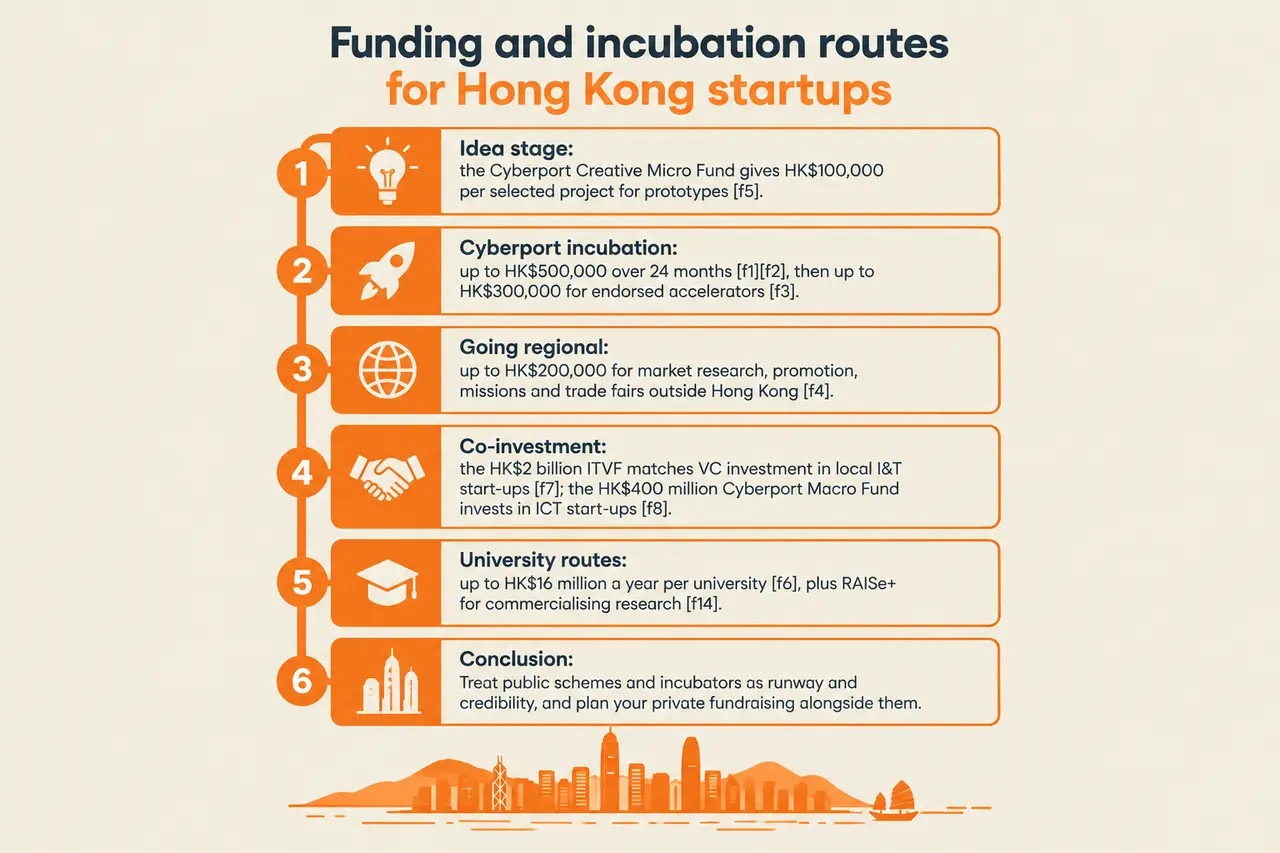
Government schemes also cover market development and research. Cyberport's Overseas and Mainland Market Development Support Scheme subsidises up to HK$200,000 for market research, promotion, business missions and trade fairs outside Hong Kong. That matters if you plan to expand into the Greater Bay Area, Taiwan or Southeast Asia. University spin-outs can tap the Technology Start-up Support Scheme for Universities, which funds each of six local universities with up to HK$16 million a year. RAISe+, launched in 2023, helps universities commercialise R&D outcomes.
Private capital sits alongside these schemes. The Innovation and Technology Venture Fund is HK$2 billion and co-invests with venture capital funds in local I&T start-ups on a matching basis. So a private lead investor can unlock public money. Angels and VCs look for a clear problem, a team that can execute and evidence that customers care. Incubator acceptance helps credibility, but it does not replace traction.
Startup competitions offer prize money, mentoring and visibility. Treat them as a visibility route first. A strong pitch on stage gets you in front of judges, investors and press. Cyberport's iStartup@HK platform also connects start-ups to investors and users through virtual pitching.
Treat public schemes and incubators as runway and credibility, and plan your private fundraising alongside them rather than after them.
- Cyberport incubation: up to HK$500,000 over 24 months, then up to HK$300,000 for endorsed accelerators.
- Idea stage: the Cyberport Creative Micro Fund gives HK$100,000 per selected project for prototypes.
- Going regional: up to HK$200,000 for market research, promotion, missions and trade fairs outside Hong Kong.
- Co-investment: the HK$2 billion ITVF matches VC investment in local I&T start-ups; the HK$400 million Cyberport Macro Fund invests in ICT start-ups.
- University routes: up to HK$16 million a year per university, plus RAISe+ for commercialising research.
Startup Events and Communities in Hong Kong Worth Your Time
Two flagship events anchor the calendar. The StartmeupHK Festival gathers founders, investors and corporates around InvestHK's startup push. Hong Kong FinTech Week draws the fintech, banking and regulatory crowd. Both are useful if your buyers or investors attend. Neither will help much if you only wander the halls.

Smaller communities often give you more. Meetup lists 40,509 members across 31 technology startup groups in Hong Kong. They include Startup Grind Hong Kong, ProductTank Hong Kong, Garage Society and Dim Sum Labs. Startup Grind leans towards founder stories and fundraising. ProductTank suits product managers. Dim Sum Labs is a hackerspace for builders and hardware tinkerers.
Coworking hubs double as communities. Garage Society runs events for members and guests. Cyberport also offers Smart-Space units on agreements of one to 12 months at an all-inclusive fixed price. Its offsite co-working space in Tsuen Wan is around 20,000 sq ft and can house around 140 start-ups. HKSTP's Lion Rock 72 at InnoCentre in Kowloon Tong provides 10,000 sq ft of 24-hour collaborative space.
To find events, filter Meetup and Eventbrite by date, format and price. Favour recurring events over one-offs. Then use events to get seen, not only to network. Ask to demo. Offer to speak on a panel. Bring a short, local example of your product solving a real problem. People remember a product they saw working far longer than a card in a pile.
Pick a few communities that match your audience, show up regularly and show your product, because being remembered matters more than collecting business cards.
| Community or event | Who you meet | Best use |
|---|---|---|
| StartmeupHK Festival | Founders, investors, corporates, overseas delegations | Meeting investors and partners; regional exposure |
| Hong Kong FinTech Week | Fintech founders, banks, regulators | Fintech partnerships and buyer conversations |
| Startup Grind Hong Kong | Early-stage founders and angels | Founder peer network and fundraising contacts |
| ProductTank Hong Kong | Product managers and designers | Product feedback and early adopters |
| Dim Sum Labs and Garage Society | Builders, hackers, coworking members | Demos, testing and hands-on feedback |
| HKCS StartupHub Connect Series | Founders across Science Park and Cyberport | Cross-park peer introductions |
How to Launch a Tech Product and Get It Noticed in Hong Kong and Asia
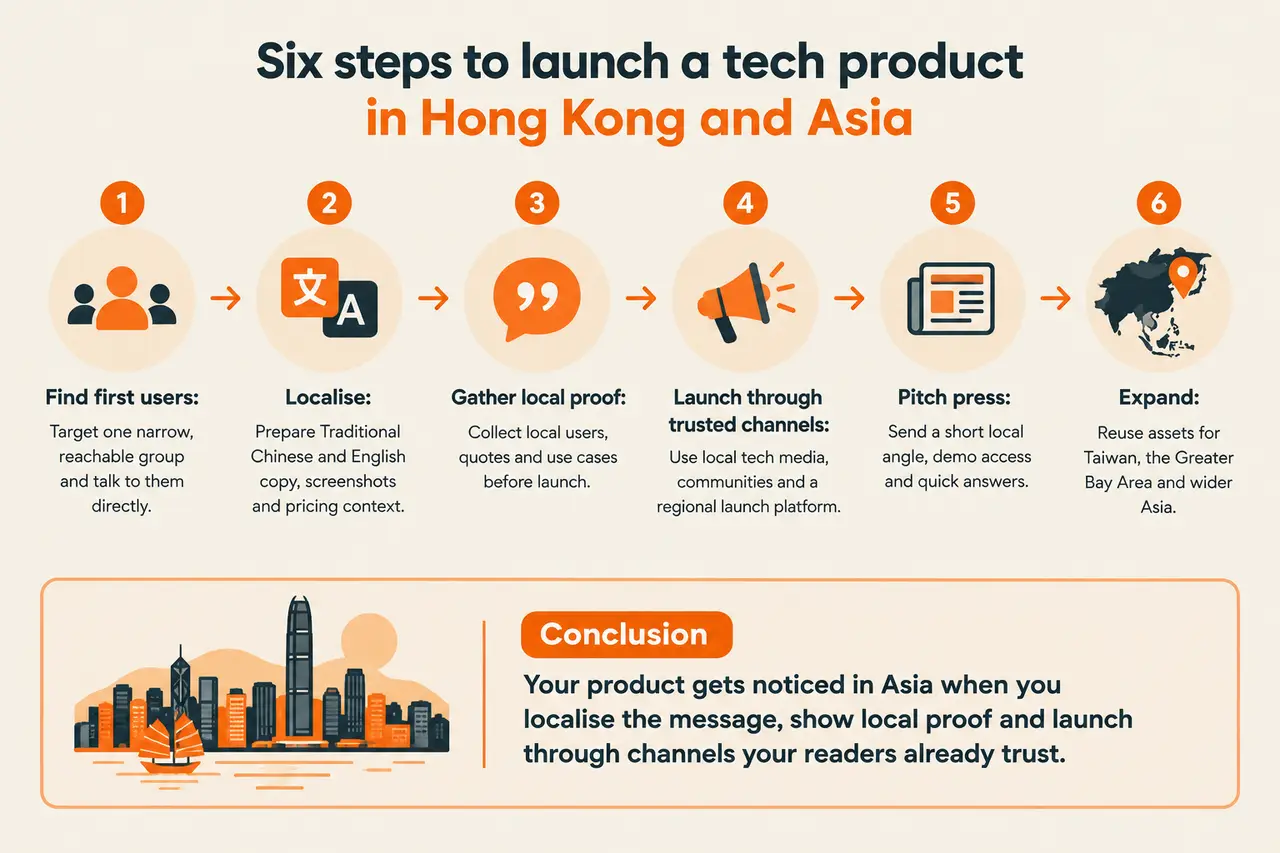
Your first users in Hong Kong are rarely found through ads alone. Start with a narrow, reachable group: a profession, a neighbourhood of businesses, a community you already know. Talk to them directly. Collect quotes and use cases. A startup in Hong Kong benefits from the city's density. Word travels fast inside small professional circles, both good and bad.
For launch channels, combine three things. First, local tech media that your audience already reads. Second, communities where your users gather, online and offline. Third, a product launch platform built for the region. On Unwire Launch you can launch your product to readers in Hong Kong, Taiwan and Asia, alongside other new tech products, rather than competing for attention in a feed built for the US.
Press in Hong Kong and Taiwan responds to a local angle. Editors want to know why your product matters here. Show a local user, a local problem or local data. Send Traditional Chinese materials, not just English. Keep your pitch short. Offer a demo account, clear screenshots and someone who can answer questions quickly. Follow up once, politely.
Asian audiences differ from US audiences in a few clear ways. Language matters: Hong Kong is bilingual, and Taiwan reads Traditional Chinese. Trust is earned through local proof: recognisable customers, local reviews, media mentions and a reachable team. Hype-heavy copy often lands worse than a calm, specific explanation of what the product does.
Hong Kong also works as a stepping stone. It shares Traditional Chinese with Taiwan. It sits next to the Greater Bay Area. It is well connected to Southeast Asia. A launch that works here gives you localised assets and proof you can reuse when you expand.
Your product gets noticed in Asia when you localise the message, show local proof and launch through channels your readers already trust, not by copying a US launch playbook.
| Launch step | What to do | Why it matters in Asia |
|---|---|---|
| Find first users | Target one narrow, reachable group and talk to them directly | Dense professional circles spread word quickly |
| Localise | Prepare Traditional Chinese and English copy, screenshots and pricing context | Bilingual Hong Kong and Chinese-reading Taiwan expect it |
| Gather local proof | Collect local users, quotes and use cases before launch | Trust depends on recognisable, local evidence |
| Launch through trusted channels | Use local tech media, communities and a regional launch platform | Readers act on sources they already follow |
| Pitch press | Send a short local angle, demo access and quick answers | Editors need a reason the product matters here |
| Expand | Reuse assets for Taiwan, the Greater Bay Area and wider Asia | A Hong Kong launch builds a regional base |
Common Mistakes, Realistic Effort and Who Hong Kong Suits
The most common mistake is mistaking incubator acceptance for market traction. Getting into Cyberport or HKSTP is a good signal. It gives you runway and contacts. It does not prove that customers will pay. Keep talking to users from day one.
The second mistake is launching in English only to a bilingual audience. Many Hong Kong users read English, but they trust and share content in Chinese. Taiwan expects Traditional Chinese. English-only launches tend to reach a narrower slice than founders expect.
The third mistake is underestimating effort. A launch is not a single day. You need preparation, the launch itself and weeks of follow-up: replying to comments, updating media, sharing early results and fixing what users report. Plan your team's time for that tail.
Hiring is its own challenge. Local talent is strong in finance, engineering and operations, but competition is real. You can hire directly, use headhunters for senior roles or use an employer of record if you are testing the market before forming a company. Choose based on how committed you are to Hong Kong.
Hong Kong suits founders who sell to finance, professional services or regional businesses. It suits teams who want access to Asian capital and a base for Taiwan, the Greater Bay Area and Southeast Asia. It may suit you less if your customers are mainly elsewhere and you need low-cost space and large local hiring at scale.
Plan for the launch to take sustained effort after day one, and use Hong Kong as a base only if its customers, capital or regional reach fit your product.
- Mistaking incubator acceptance for traction: keep validating with paying users.
- Launching in English only: localise into Traditional Chinese for Hong Kong and Taiwan.
- Underestimating effort: budget time for weeks of follow-up after launch day.
- Hiring blind: decide between local hires, headhunters or an employer of record based on your commitment.
- Choosing the wrong base: pick Hong Kong if its customers, capital or regional reach fit your product.
Related articles
Startup Hong Kong: Frequently Asked Questions
What is StartmeupHK and who runs it?
StartmeupHK is the startup arm of InvestHK, the Hong Kong government department that attracts overseas business. It helps founders set up or expand in Hong Kong with guidance, introductions and programme referrals. It also runs the StartmeupHK Festival. It guides you rather than funding you directly.
How does an overseas founder set up a startup in Hong Kong?
Start with StartmeupHK for setup and visa guidance. Then incorporate your company, open a bank account and choose a base, such as Cyberport, HKSTP or a coworking hub. Apply to an incubator that matches your sector. Line up local users early so you arrive with a launch plan, not only paperwork.
What incubators and accelerators can startups join in Hong Kong?
The main ones are Cyberport and HKSTP. Cyberport incubation offers up to HK$500,000 over 24 months, plus up to HK$300,000 for endorsed accelerators. HKSTP runs incubation and a 24-month Co-Acceleration Programme. Universities also run their own programmes.
What government funding is available for startups in Hong Kong?
Funding includes incubation grants, the HK$100,000 Creative Micro Fund for prototypes and up to HK$200,000 for market development outside Hong Kong. The HK$2 billion ITVF co-invests alongside VCs. University spin-outs can use university schemes and RAISe+.
Where can founders meet investors and other entrepreneurs in Hong Kong?
Meet them at flagship events like the StartmeupHK Festival and Hong Kong FinTech Week, and at Meetup groups. Meetup lists 40,509 members across 31 technology startup groups in Hong Kong. Cyberport's iStartup@HK also connects start-ups to investors through virtual pitching.
How do you get your tech product noticed in Hong Kong and wider Asia?
Localise your message, show local proof and launch through channels your readers already trust. Prepare Traditional Chinese materials, collect local users and quotes, pitch local tech media with a local angle and use a regional launch platform. Then follow up for weeks after launch day.
Your Next Step: From Set Up to Seen
Hong Kong gives you strong scaffolding. Support bodies help you land. Incubators and schemes give you runway. Communities give you peers and early feedback. None of that puts your product in front of the people who will use it.
So map your next move in order. Pick the support body that fits your sector. Line up funding alongside your fundraising, not after it. Choose a few communities and show up regularly. Then prepare a localised launch with local proof.
When you are ready to go public, Unwire Launch is one place to put your product in front of readers in Hong Kong, Taiwan and wider Asia. Whatever channel you choose, plan for the follow-up. In this market, being set up is only the start. Being seen is the goal.